Story · Why I work for myself June 2026
Why I bet on myself and went freelance
I didn't chase it — it arrived almost by accident. But looking back, everything pointed here: betting on myself and raising my risk tolerance instead of buying a false sense of stability.
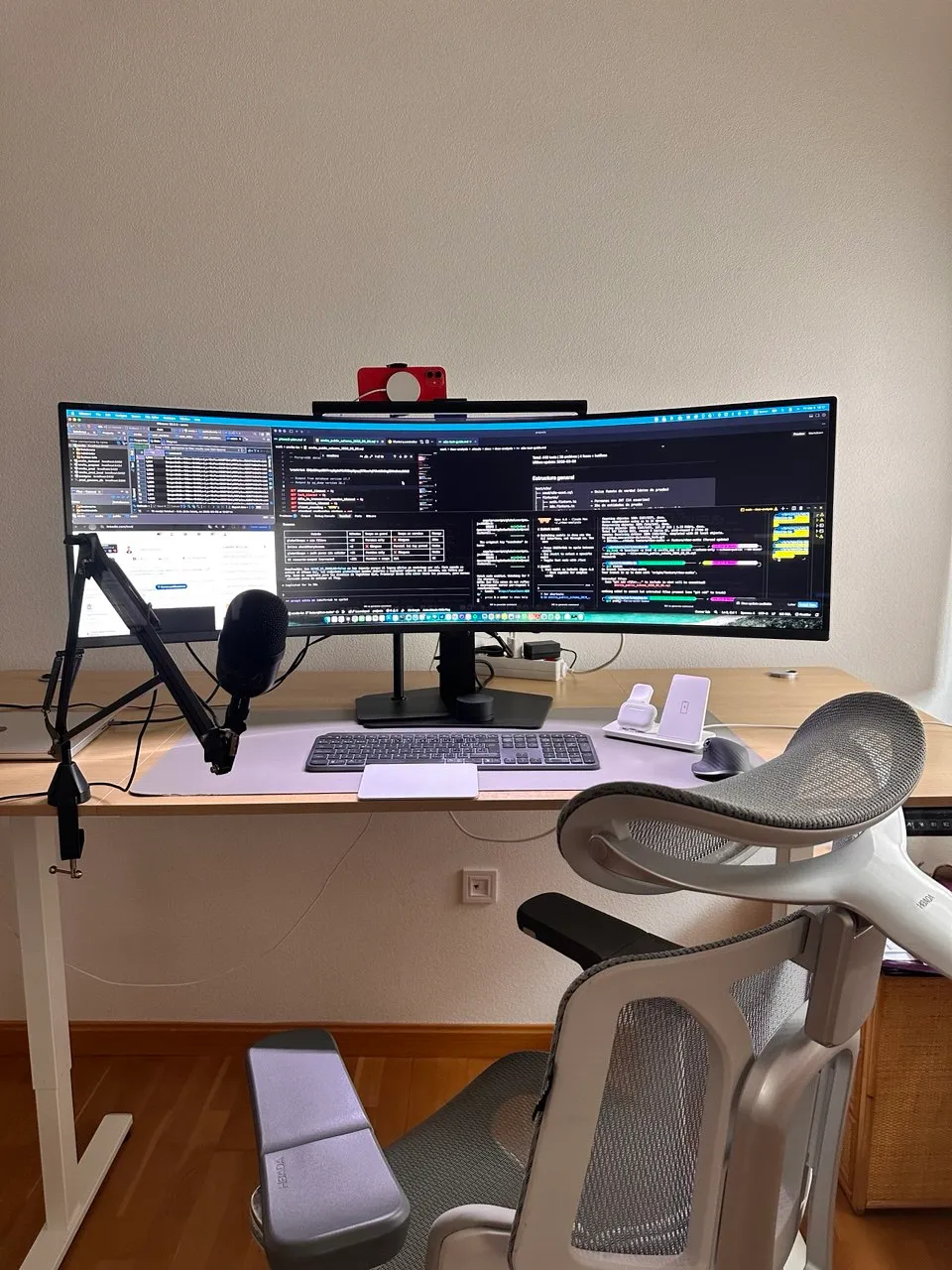
I went freelance more by accident than by anything I deliberately chased. And yet, when I look back with some perspective, it feels like it was always in my nature.
What I want is to work for myself. Here I lay out where that comes from, what pushes me, and what I'm willing to risk.
I didn't look for it, but it was always there
#s1I've always liked building things on my own. Having flexibility, the freedom to innovate, and room to find solutions that aren't the ones on the marked path. This wasn't a decision I made one Monday morning: it's a way of operating I've been carrying for a long time.
I'd already taken the self-employed leap once. Back in 2017, with Yodono, alongside a partner and around a business idea of our own. It wasn't freelance in the strict sense — I wasn't selling my services by the hour or doing fixed-scope projects — it was a product of ours, a shared bet. So what I'm doing now isn't exactly "going back" to the same thing. It has a different shape, but it comes from the same place: wanting to build something of my own.
Before software, there was creativity
#s2If I'm honest, as a kid I wasn't drawn to software itself. What drew me was making things for other people, and reaching for whatever technology I had on hand to pull it off.
It started on the creative side. When I was a kid I made AMVs (anime music videos) and uploaded them to YouTube, where we built up several communities and connected with people from all over the world. I spent a huge amount of time there, on the creative side, long before I wrote a single line of code.
Software came later and multiplied that capacity exponentially. Today I genuinely believe that's my best skill: the creative part, that knack for connecting pieces and innovating that comes to me innately. And underneath it sits a value that hasn't shifted: wanting to be better and leave a good impact on whatever I touch.
Why now
#s3What pushes me to take the step at this stage is simple: today I have the technical knowledge, the tools, and the determination to pull it off. All three at once, which don't always coincide.
And it comes with a passion for technology, for software itself, that makes time fly. I love what I do. When I sit down at the computer I feel a kind of symbiosis, and that's what gets me up every morning — even on the days when I don't really feel like it.
See the pattern, build the solution
#s4There's something I do almost without thinking: spot patterns. I see a pain, a problem that keeps repeating, and I immediately think it could be solved with software.
And then I try. A lot of the time I build tools for myself, tools nobody asked me for. I ship them anyway, because solving that challenge is, in itself, a huge satisfaction. If I can also live off it, even better. That's the point I'm at right now, plainly put. But I can't lose sight of the fact that at some point I'll have to optimize the living-off-it part. I suppose that's a result that will come on its own.
A system that doesn't scale (and that's fine)
#s5I'm well aware that this, as it is, doesn't scale. It isn't designed to. Who knows whether later on I'll set up something that does, but that's not what this moment is about.
I'm in a growth stage, and the engine is something else: the hunger to know more about the world of software. That thirst for knowledge, for lack of a better phrase, is what moves me every day. I'm optimizing to learn.
Rejecting the illusion of stability
#s6For all of this I've had to accept an uncomfortable idea: that a good part of the stability of a job is an illusion. Funnily enough, right as I was going freelance, the company I'd been working for carried out mass layoffs and let go of more than 700 employees across Spain.
When you invest in yourself, you're investing in knowledge, and that investment comes back. You pour all your effort into getting better without the shelter of a company paying you for it. It's a different kind of effort, more exposed, and precisely because of that it's more rewarding.
// the betI'd rather invest in myself and accept the risk than buy a feeling of security that, deep down, doesn't really exist either.
Training my risk tolerance
#s7Going freelance means taking on risk — I won't hide that. But I don't see risk as a fixed number; more like a muscle you train, so I can reach a little further each time.
That exposure teaches you to trust yourself more. And you reach a point where it's clear you'd regret not trying more than trying and failing.
- Knowing that, in the worst case, I can get back up and do it better makes me stronger.
- I'm aware there can be ups and downs, and when I hit that critical moment, I'll know I can get back up and try again.
This isn't a knock on being employed
#s8None of this means you can't grow as an employee. Of course you can — but within your company's framework, and that isn't necessarily a bad thing. It's just that, right now, I want to explore other facets that make me grow.
A few months in, I feel I'd have deeply regretted not trying — regretted staying on as someone else's employee.
Consistency beats intelligence
#s9I've had, and still have, colleagues far smarter than me. I say that without any hang-ups. But I've seen first-hand that the consistency I bring to the work ends up beating raw ability or talent by a wide margin.
I see it like physical training. At the gym, the one who makes progress isn't the person who binges for a day and then vanishes for three weeks — it's the one who trains moderately but steadily. Work is the same: a moderate, sustained consistency weighs more than the heroic effort of a single day. And that doesn't happen on its own — it takes structure: a plan, and the discipline to follow it so you actually manage your time.
Working for myself makes whatever talent I have bloom faster. And there's something that multiplies all of it: trust. It's incredible how much you can do when you trust yourself and, on top of that, you're lucky enough to surround yourself with people who believe in you a little. That alone is already a lot; it gives you a brutal amount of energy.
I don't experience this as an exercise in self-persuasion, but in proof. I don't tell myself the story: I prove it to myself.
// what actually scalesConvincing myself matters, but beyond that I have to prove it to myself, one consistent hour after another.
I didn't get here on my own
#s10Being where I am today is also the result of many people who, at some point, believed in me a little and gave me the fuel to keep moving. I remember every one of those who made me feel capable of doing this, because very often it's the confidence others place in you that pushes you forward too.
// thank youThe small good acts we offer other people often don't pass unnoticed: they push someone to want to be better.
Even if it goes wrong
#s11I'm aware the results aren't immediate. Plenty of people try this path — freelance, or a project of their own — and sometimes the environment, or simply luck, doesn't line up. These things can happen.
But I still think the same thing: it's better to regret what you try than what you don't. And if in the end it doesn't work out, I've already gained something no one can take away: the clear conscience of having tried, and of having given it everything.
Because if tomorrow I have to try again, I'll do it better prepared and better than today. And right now I feel, clearly, that I have to try.