Personal automation · Claude Code Channels (research preview), MCP plugins, Telegram Bot API
Claude Code Channels + Telegram → Automated Private Blog
A remote input pipeline that turns a Telegram bot into a personal secretary: send a link from the phone, Claude Code reads it, writes a private deep-dive note, commits and pushes, and Cloudflare Pages deploys. No backend of my own.
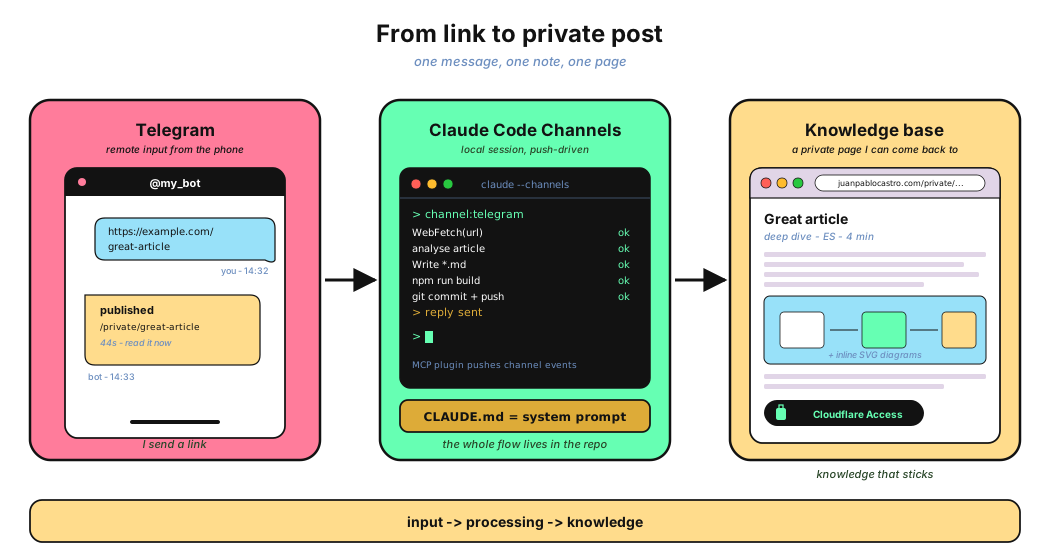
A frictionless pipeline to feed a personal /private knowledge base. Send a link from the phone, get back a Spanish deep-dive note in under a minute. No backend of my own.
Built on Claude Code Channels, a research-preview feature (v2.1.80+) that lets an MCP plugin push events directly into a running Claude Code session.
Context: the reading-debt problem #s1
Every day I stumble on something worth reading: a LinkedIn post, a third-party research article, an engineering blog, a paper. I save the link and tell myself I will come back to it. I almost never do.
A saved link is not worth much if you do not read it, do not really understand it, and cannot come back to it easily. For months — years, really — I kept piling interesting links into Notion, browser bookmarks and Telegram saved messages -> a big "black hole" where links accumulated but which I rarely came back to. When I did, I would feed them through the grinder (ChatGPT, which explained them well but sometimes way too tersely), and a few months later it was never that easy to find any of it again, buried in an endless list of old chats.
The framing here is borrowed. I ran into it first in Fran Pastor's post "Tu WhatsApp de links no es conocimiento" (linked at the bottom of the page), which diagnoses the same debt and builds an autonomous agent to triage a multi-source firehose (Gmail, Twitter, newsletters) down from thousands of signals to a handful worth reading. Same diagnosis, different prescription and different stack: I do not have a firehose to filter, I have a single curated stream that needs processing depth.
- The bottleneck is not discovery. At this point I do not need a filter, a feed, or a scoring layer. For me that is the human-in-the-loop part... sharing with colleagues, debating it out... we are still human and communication is key.
- The bottleneck is comprehension. I like things explained at the exact level that lets me understand them deeply — against my stack, my strengths, my blind spots.
- I want to come back to it. Not just read it once — keep it, revisit it, build on it, quote it into future work.
The real value: a personal knowledge manager #s2
This project is not really about a Telegram bot. It is about turning a captured link into a page on a private site that belongs to me, explained the way I learn best, stored where I already look for what I know.
- Input -> a single link sent to a private bot from my phone.
- Output -> a deep-dive Spanish note on my own private site, behind Cloudflare Access, alongside the rest of my knowledge base.
- Why it works -> the system already knows me.
CLAUDE.mdencodes my stack, my level, how I like things explained, which analogies land and what I already take for granted. - Every post is tailored. Same link sent by someone else would produce a different note. The system's job is not to summarise — it is to translate the source into my mental model.
- The knowledge compounds. Notes live in git, versioned, searchable, and reachable from the same URL scheme as the rest of the site. Future-me can find them.
- The friction is gone. From the moment I see a link to the moment a private page exists that explains it at my level: about one minute, zero context switch, zero editor open.
The idea: push, not pull #s3
A channel inverts the control flow of MCP. Instead of Claude reaching out to a tool, the plugin pushes an event straight into the live session.
- Traditional MCP -> Claude is the initiator. It asks, the server answers.
- Channel -> the plugin is the initiator. It pushes a prompt straight into Claude Code.
- A DM to a private bot of mine becomes a remote input that lands in my terminal as if I had typed it.
- Entirely local. The plugin runs next to Claude Code, nothing public is exposed.
- The flow itself lives in
CLAUDE.md, colocated with the code of the site it feeds.
End-to-end architecture #s4
Three local pieces cooperate. Only two interactions cross the public internet.
- Telegram Bot API -> Bun-based channel plugin (polls
getUpdates). - Channel plugin -> Claude Code session. Pushes the message as a
<channel>prompt. - Claude Code ->
WebFetch+Write+npm run build+ git commit/push + reply to Telegram. - GitHub -> Cloudflare Pages build -> site redeployed behind Cloudflare Access.
- Only two things leave my laptop: the Telegram poll and the final
git push.
Infrastructure that collapses #s5
The naive design would need five public moving pieces. Channels collapse that to three local ones.
- Removed -> Cloudflare Worker hosting a Telegram webhook.
- Removed -> bot token sitting at the edge.
- Removed -> GitHub App or PAT with write access to the repo.
- Removed -> a Claude API call from the Worker and its API key.
- Removed -> a public HTTPS endpoint to secure and monitor.
- Kept -> a long-running
claude --channelssession, the Telegram plugin, andCLAUDE.md. All local. - Only trade-off -> the session must be alive somewhere.
Why not Lambda, a Worker, or a hosted automation #s6
I considered every obvious shape before settling on channels. None of them fit a curated, reactive, deep-dive-per-message use case cheaply or simply.
- AWS Lambda + API Gateway + Claude API -> you are running a whole service for a one-person flow. You pay for invocations, pay for the gateway, pay per token for the LLM, and maintain the Terraform for something you send a few links a week to.
- Cloudflare Worker + Telegram webhook -> cheaper per invocation, but you still host a public HTTPS endpoint, still store the bot token on the edge, and still need a GitHub App or PAT with write access to push commits back.
- Zapier / Make / n8n -> shallow. You get "fetch URL" and "call LLM" steps, but not a deep-dive-with-diagrams-in-Spanish flow driven by the repo's own
CLAUDE.md. You cannot point it at project conventions, so you end up rewriting half of the logic anyway. - A self-hosted daemon -> closest in spirit, but you own the bot-API polling, the reconnect logic, the secret management, the deploy pipeline and the alerting. You just rebuilt the channels plugin by hand.
- Claude Code Channels -> the one shape where everything collapses. MCP already exists, Claude Code is already running,
CLAUDE.mdis already the system prompt. I add a plugin and one CLI flag. The flow is live.
Costs #s7
This pipeline adds zero marginal dollars per post. No new line item. Everything rides on tools I already pay for or use.
- Telegram bot -> free. The Bot API has no pricing.
- Claude Code subscription -> the basic ~€30/month plan is enough. Channel events consume the same monthly allowance as any other Claude Code session. At my volume (a handful of posts per week, ~2k words each) it fits comfortably inside the basic tier.
- Cloudflare Pages -> free tier (500 builds / month, unlimited sites).
- Cloudflare Access -> free on the Zero Trust plan for up to 50 users.
- GitHub -> free for public repos.
- Bun -> free runtime for the channel plugin.
- Compare with the Lambda shape: API Gateway invocations + Lambda compute + per-token Claude API + CloudWatch logs + Terraform state bucket + domain + TLS + maintenance time. Low dollars, but non-zero, and you own the bill.
- My flow adds exactly one artefact per run: a new commit in git. Nothing to monitor, renew, or rotate.
Setup and pairing #s8
The happy path is short and strictly ordered. Pair first, lock immediately.
- 1. Prereqs -> Claude Code v2.1.80+, a claude.ai login (Pro / Max / Team), and Bun.
- 2. Install ->
/plugin install telegram@claude-plugins-official. - 3. Configure ->
/telegram:configure <token>. Token stored with600permissions in~/.claude/channels/telegram/.env. - 4. Start ->
claude --channels plugin:telegram@claude-plugins-official. - 5. Pair -> DM the bot, paste the returned code into
/telegram:access pair <code>. - 6. Lock -> immediately run
/telegram:access policy allowlist. - Never leave the bot in
dmPolicy: "pairing". Anyone who finds it can request a fresh code.
# Inside a Claude Code session
/plugin install telegram@claude-plugins-official
/reload-plugins
/telegram:configure <token>

# Restart Claude Code with the channel enabled
claude --channels plugin:telegram@claude-plugins-official

# Pair your Telegram account, then immediately lock the bot
/telegram:access pair <code>
/telegram:access policy allowlistSecurity model #s9
The bot handle is public, like an email address. Everything that actually protects the flow lives below it.
- Drive-by DMs are dropped at the plugin.
dmPolicy: "allowlist"plus a singleallowFromentry means any unknownsenderIdis discarded before reaching Claude. - SenderId spoofing is infeasible. Telegram signs it server-side. The only realistic path is account takeover, closed by Telegram Two-Step Verification.
- Real threat: prompt injection via fetched content. A hidden "ignore previous instructions" in a linked page could push Claude toward unintended tool calls.
- Mitigation: per-invocation tool-use approvals. Every
Write,Bashorgit pushpops an Allow / Deny button on my phone. - The channel cannot widen Claude's tool surface or escape the working-directory sandbox. It only delivers a prompt.
- The one switch that would break the model,
--dangerously-skip-permissions, is kept out of this flow.
CLAUDE.md as the system prompt #s10
The flow is not code. It is a short section in the repo's own CLAUDE.md, read by Claude Code once per session.
- Language -> Spanish.
- Depth -> deep dive, senior backend reader.
- Structure -> TL;DR -> Contexto -> Cómo funciona -> Puntos clave -> Cómo aplica a mi stack -> Opinión crítica.
- Diagrams -> inline SVG, white-poster background with a fixed palette. Renders identically in light and dark mode.
- Destination ->
src/content/private/<slug>.md, committed and pushed to master. - The repo that hosts the site also defines how the site gets fed. No wrapper script, no separate service.
## Telegram Channel -> Private Blog Posts

When a message arrives via the Telegram channel containing a URL:

1. Fetch the link content (WebFetch)
2. Analyze the content thoroughly
3. Generate a private blog post following the style guide
4. Save as src/content/private/<slug>.md
5. Run `npm run build` to verify
6. Commit & push to master
7. Reply via Telegram with the slug and live URL

Style guide: Spanish, deep dive, inline SVG diagrams on the
white-poster palette, structure TL;DR -> Contexto -> Cómo funciona
-> Puntos clave -> Cómo aplica a mi stack -> Opinión crítica.Trade-offs #s11
- Session-dependent by design -> the pipeline is only live while the Claude Code session is running. No offline queueing on my side.
- Why it still works for me -> my laptop is up ~24/7 with a long-running
claude --channelssession, so the pipeline is effectively always reachable. - If the machine is off -> Telegram does the queueing for me. Messages sent to the bot sit inside Telegram's own servers until I open the channel again; the plugin then replays them in order via
getUpdates. Nothing is lost, nothing reaches Claude until I reopen the session. - Research preview -> the
--channelscontract is not frozen yet. Expect changes. - Per-invocation tool-use approvals break the "send a link and walk away" ergonomics.
- The only escape,
--dangerously-skip-permissions, is exactly what it sounds like and has no place in a shared setup. -
git pushstraight to master is convenient but risky. Safer v2: push to acontent/telegram-<date>branch, auto-merge only on green build.